






Frequently asked questions
SUPADIVERTA
3 in 1 Supadiverta rain water capture system
Q. Do you have any hints & tips?
A. Yes we do! Check out the Handy Hints Page
Q. Why should I use a supadiverta?
A. The 3 in 1 SUPADIVERTA is versatile, cost effective, easy to fit, low maintenance and provides cleaner and neater rainwater capture from multiple downpipes. WATCH THE VIDEO and see for yourself!
A. The 3 in 1 SUPADIVERTA is versatile, cost effective, easy to fit, low maintenance and provides cleaner and neater rainwater capture from multiple downpipes. WATCH THE VIDEO and see for yourself!
Q. How can a small head of water in a small pipe push against the weight of the water in the tank?
A. The water in the pipe is `pushed’ at one end by positive head pressure and `pulled’ at the other end by the lower head pressure in the tank. This also explains why flow in the pipe accelerates once syphonic conditions are established. The weight of the water at each end is irrelevant as the full flow of water is one mass.
Q. If syphonic flow is so good, why doesn't everyone use it?
A. Most of the world’s largest stadiums, skyscrapers and industrial roofs use revolutionary syphonic (aka siphonic) drainage because they can use smaller pipes to move more water faster. We use exactly the same principle inside the Supadiverta. Check it out!

Q. What is Supadiverta made of?
A. SUPADIVERTA is made from U.V. resistant ASA; a tough recyclable plastic that has superior resistance to outdoor exposure and ageing.
Q. What is the main use of SUPADIVERTA?
A. SUPADIVERTA evolved from a project created to address house cracking - brick cracking issues but the cost savings, versatility and aesthetic benefits when used with rainwater tank installations has created the most interest. SUPADIVERTA is also popular with gardeners to provide additional water to dry areas and is our largest market.
A. SUPADIVERTA evolved from a project created to address house cracking - brick cracking issues but the cost savings, versatility and aesthetic benefits when used with rainwater tank installations has created the most interest. SUPADIVERTA is also popular with gardeners to provide additional water to dry areas and is our largest market.
Q. Does fitting a rainhead or diverter into a downpipe create a greater potential for blockages?
A. Rainheads and downpipe diverters can block if...
The flow path to stormwater is restricted.
The rainhead or filter creates a barrier across the downpipe's flow path to stormwater.
The SUPADIVERTA will not cause any blockage
The SUPADIVERTA inlet is free flowing with no dead ends.
SUPADIVERTA diverts water through a 750 micron filter before entering the internal reservoir, making it impossible for the outlets to block.
The SUPADIVERTA filter is set at a 50 degree angle and IS NOT POSITIONED ACROSS THE FLOW PATH TO STORMWATER.
For quality rainwater harvesting, gutters should be regularly cleaned or fitted with suitable gutter mesh.
A. Rainheads and downpipe diverters can block if...
The flow path to stormwater is restricted.
The rainhead or filter creates a barrier across the downpipe's flow path to stormwater.
The SUPADIVERTA will not cause any blockage
The SUPADIVERTA inlet is free flowing with no dead ends.
SUPADIVERTA diverts water through a 750 micron filter before entering the internal reservoir, making it impossible for the outlets to block.
The SUPADIVERTA filter is set at a 50 degree angle and IS NOT POSITIONED ACROSS THE FLOW PATH TO STORMWATER.
For quality rainwater harvesting, gutters should be regularly cleaned or fitted with suitable gutter mesh.
Q. We get leaves in the gutters but the gutters never actually block. We want to harvest rainwater but we are concerned about no longer having rainwater flushing out the storm water pipes if we fit some Supadivertas. How can we manage this?
A. Long term testing has determined that the filter sacrifices about 4% yield to storm water except during extreme rainfall events or when tanks are nearly full. This yield loss is exceptionally low. Aquatrek recommends that the storm water is occasionally flushed and when multiple Supadivertas are plumbed to an average sized tank, the tank quickly fills and the stormwater is regularly flushed.
If excess debris may be diverted to storm water, AQUATREK recommends fitting the Fielders Watergate zinc gutter mesh. This inexpensive product is suitable for most eaves gutters, is sold in 8 X 1.25 metre packs and is easy DIY. AQUATREK also recommends leaving a maintenance access gap every couple of metres.
Another option is to drain to a trendy rain garden to biologically filter debris and contaminants before draining to storm water.
Fitting a small leaf diverter under the Supadiverta is a third option. AQUATREK has developed several advanced leaf diverters to fit under the Supadiverta but a final product release is yet to be determined.
Q. What if I want to clean my gutters, how do I stop dirt going through the filter and into the reservoir?
A. Wrapping a few layers of Glad Wrap or similar around the filter will prevent this. The filter is also easily cleaned by back flushing with a garden hose.
A. Long term testing has determined that the filter sacrifices about 4% yield to storm water except during extreme rainfall events or when tanks are nearly full. This yield loss is exceptionally low. Aquatrek recommends that the storm water is occasionally flushed and when multiple Supadivertas are plumbed to an average sized tank, the tank quickly fills and the stormwater is regularly flushed.
If excess debris may be diverted to storm water, AQUATREK recommends fitting the Fielders Watergate zinc gutter mesh. This inexpensive product is suitable for most eaves gutters, is sold in 8 X 1.25 metre packs and is easy DIY. AQUATREK also recommends leaving a maintenance access gap every couple of metres.
Another option is to drain to a trendy rain garden to biologically filter debris and contaminants before draining to storm water.
Fitting a small leaf diverter under the Supadiverta is a third option. AQUATREK has developed several advanced leaf diverters to fit under the Supadiverta but a final product release is yet to be determined.
Q. What if I want to clean my gutters, how do I stop dirt going through the filter and into the reservoir?
A. Wrapping a few layers of Glad Wrap or similar around the filter will prevent this. The filter is also easily cleaned by back flushing with a garden hose.
Q. I understand why the flush outlet is level with the floor, but why are the other two outlets set at two different heights?
A. Primarily, it allows the outlets to act as a gear box for varying flow conditions.
It also provides a greater versatility of use by prioritising flow. For example, when harvesting to two rainwater tanks, one can be given priority over the other. As the first tank fills or if the rain intensity increases, the Supadiverta’s reservoir level will rise and the taller outlet will begin filling the second tank. The same scenario applies to different garden areas.
When rainfall is insufficient to divert through both outlets, the taller outlet serves as an air purge valve to vent the connecting horizontal pipe.
Q. Why are the anti vortex baffles angled?
A. Water falling even a short distance into a body of water creates a lot of bubbles. The baffles deflect large bubbles and prevent a lot of bubbles entering the outlets.
A. Primarily, it allows the outlets to act as a gear box for varying flow conditions.
It also provides a greater versatility of use by prioritising flow. For example, when harvesting to two rainwater tanks, one can be given priority over the other. As the first tank fills or if the rain intensity increases, the Supadiverta’s reservoir level will rise and the taller outlet will begin filling the second tank. The same scenario applies to different garden areas.
When rainfall is insufficient to divert through both outlets, the taller outlet serves as an air purge valve to vent the connecting horizontal pipe.
Q. Why are the anti vortex baffles angled?
A. Water falling even a short distance into a body of water creates a lot of bubbles. The baffles deflect large bubbles and prevent a lot of bubbles entering the outlets.
Q. Will the flow of water through a tank’s bottom inlet stir up the sediment?
A. Quite the opposite!
Research has demonstrated that full flow rapidly dissipates through a correctly sized inlet fitted a minimum 100 mm above the bottom of the tank. This contrasts with conventional rainwater harvesting whereby water falling even a short distance through a tank's top meshed inlet generates toroidal vortices that travel steadily downwards due to their lack of buoyancy (no air). Significant sediment resuspension occurs when these rotating vortex rings impact on the sediment layer, particularly when water levels are low.
The worst optioned tanks are those that have the top inlet directly above a low fitted outlet that supplies the pump.
Note that water diverted by a Supadiverta has smaller and fewer foreign particles than water diverted by standard methods, resulting in less sediment. Nevertheless, AQUATREK recommends that the tank’s inlet valve is fitted within a 90 degree arc of the outlet valve that supplies the pump. Feeding through a bottom inlet also oxygenates the anaerobic zone, further improving water quality.
Several devices are available that source water from above the outlet height, eg. waterboy
Toroidal vortices can be either water or air and are an interesting and often beautiful subject. Click the links below for entertaining information about vortex rings.
Extraordinary Toroidal Vortices
Amazing Smoke Ring Launcher - Giant Air Cannon
Vortex Cannon! - Bang Goes the Theory Preview - BBC One
Vortex Ring Collision
And for the more studious...
Sediment resuspension and erosion by vortex rings
A. Quite the opposite!
Research has demonstrated that full flow rapidly dissipates through a correctly sized inlet fitted a minimum 100 mm above the bottom of the tank. This contrasts with conventional rainwater harvesting whereby water falling even a short distance through a tank's top meshed inlet generates toroidal vortices that travel steadily downwards due to their lack of buoyancy (no air). Significant sediment resuspension occurs when these rotating vortex rings impact on the sediment layer, particularly when water levels are low.
The worst optioned tanks are those that have the top inlet directly above a low fitted outlet that supplies the pump.
Note that water diverted by a Supadiverta has smaller and fewer foreign particles than water diverted by standard methods, resulting in less sediment. Nevertheless, AQUATREK recommends that the tank’s inlet valve is fitted within a 90 degree arc of the outlet valve that supplies the pump. Feeding through a bottom inlet also oxygenates the anaerobic zone, further improving water quality.
Several devices are available that source water from above the outlet height, eg. waterboy
Toroidal vortices can be either water or air and are an interesting and often beautiful subject. Click the links below for entertaining information about vortex rings.
Extraordinary Toroidal Vortices
Amazing Smoke Ring Launcher - Giant Air Cannon
Vortex Cannon! - Bang Goes the Theory Preview - BBC One
Vortex Ring Collision
And for the more studious...
Sediment resuspension and erosion by vortex rings
Q. We want to collect all the rainwater but separate and retain the dirty water. How do we do this?
A. The cleaner water diverted through the second and third outlets would be transferred to a tank as usual and the first flush water manually drained and used separately. To collect the water diverted to storm water, simply divert the bottom downpipe to a small tank’s top meshed inlet.
A. The cleaner water diverted through the second and third outlets would be transferred to a tank as usual and the first flush water manually drained and used separately. To collect the water diverted to storm water, simply divert the bottom downpipe to a small tank’s top meshed inlet.
Q. I have pine needles in my gutters; will they get stuck in the filter?
A. This is possible but AQUATREK is conducting tests and has not encountered problems to date. The designed back flushing should remedy the situation and an internal inspection of the SUPADIVERTA a couple of times a year is recommended.
Pine needles can make water acidic and should, if possible, be prevented from entering gutters. Acidic water can damage pipes, pumps and fittings. Leaves and other debris can also alter rainwater PH levels.
A. This is possible but AQUATREK is conducting tests and has not encountered problems to date. The designed back flushing should remedy the situation and an internal inspection of the SUPADIVERTA a couple of times a year is recommended.
Pine needles can make water acidic and should, if possible, be prevented from entering gutters. Acidic water can damage pipes, pumps and fittings. Leaves and other debris can also alter rainwater PH levels.
Q. We have a large tank in the backyard and a first flush diverter is fitted at the top of the wet system's vertical riser. We also installed rainheads at the top of the downpipes and were informed this would clean the water going to the tank. When we drain the first flush, the water is always clean and yet we recently had to dig up the buried pipe work to remove a blockage that looked like congealed tar and grit. We cannot understand where the tar has come from. We have a tiled roof. Any ideas?
A. Wet systems retain sediment as there is insufficient velocity to transfer a lot of debris up the vertical riser and most plumbing regulations specify that wet systems must be drained after it stops raining. This is to remove trapped sediment to prevent blockages and to prevent water stagnating due to the lack of an air/water interface, a situation that promotes anaerobic (devoid of oxygen) conditions. Wet systems are not always regularly drained and the loss of water is often cited as a prime reason for not doing so.
Still water has a natural settlement process and water in the vertical riser would have settled after the last rainfall with the upper levels containing debris free water. It is this water that flows into your ‘First Flush’ diverter the next time it rains if the pipe work was not flushed. The first flush from the ‘new’ rain event would still be in the downpipe at the other end of the wet system after your first flush fills!!!
The `tar’ is probably a combination of grit and pollutants from the house roof and bacterial die off. Water trapped in a wet system’s pipe work has no open surface ventilation and the bird droppings, decayed vegetative matter and other pollutants that are not flushed to the tank due to the pipe’s low velocity allows micro organisms and bacteria to flourish. This can make the water stagnant.
If the rainhead you have fitted has a secondary fine mesh screen across the downpipe's flow path, the screen also serves as an entrapment filter and nutrient rich bird droppings will be trapped by and later flushed through the mesh to the tank. Replacing the troublesome wet system with the SUPADIVERTA system will allow the possible harvesting of additional downpipes, be neater and the internal 750 micron divert filter combined with the optional first flush kit and inline filtering will supply much cleaner water. Sediment blockages will also be a thing of the past.
A. Wet systems retain sediment as there is insufficient velocity to transfer a lot of debris up the vertical riser and most plumbing regulations specify that wet systems must be drained after it stops raining. This is to remove trapped sediment to prevent blockages and to prevent water stagnating due to the lack of an air/water interface, a situation that promotes anaerobic (devoid of oxygen) conditions. Wet systems are not always regularly drained and the loss of water is often cited as a prime reason for not doing so.
Still water has a natural settlement process and water in the vertical riser would have settled after the last rainfall with the upper levels containing debris free water. It is this water that flows into your ‘First Flush’ diverter the next time it rains if the pipe work was not flushed. The first flush from the ‘new’ rain event would still be in the downpipe at the other end of the wet system after your first flush fills!!!
The `tar’ is probably a combination of grit and pollutants from the house roof and bacterial die off. Water trapped in a wet system’s pipe work has no open surface ventilation and the bird droppings, decayed vegetative matter and other pollutants that are not flushed to the tank due to the pipe’s low velocity allows micro organisms and bacteria to flourish. This can make the water stagnant.
If the rainhead you have fitted has a secondary fine mesh screen across the downpipe's flow path, the screen also serves as an entrapment filter and nutrient rich bird droppings will be trapped by and later flushed through the mesh to the tank. Replacing the troublesome wet system with the SUPADIVERTA system will allow the possible harvesting of additional downpipes, be neater and the internal 750 micron divert filter combined with the optional first flush kit and inline filtering will supply much cleaner water. Sediment blockages will also be a thing of the past.
Q. But isn’t the SUPADIVERTA system still a wet system?
A. Yes, but there is no vertical riser and the water is transferred at greater velocity which self cleans the pipes. We also advise fitting drain valves to the horizontal pipe work. The water lost when draining pipes is much less than when draining 100 mm PVC pipe or the much thinner walled (and not recommended) 90 mm PVC pipe.
A. Yes, but there is no vertical riser and the water is transferred at greater velocity which self cleans the pipes. We also advise fitting drain valves to the horizontal pipe work. The water lost when draining pipes is much less than when draining 100 mm PVC pipe or the much thinner walled (and not recommended) 90 mm PVC pipe.
Sizing pvc pressure pipes and fittings
Q. We are in Melbourne and want to divert a high yield downpipe to a 2,000 litre tank located eight metres from the house. The tank has a 25mm inlet and will be used to top up the main tank. After reading the Supadiverta website, I now want to eliminate the overflow pipe but will I need to have a larger inlet fitted? A class 12 25mm pipe has a volume of 0.7 litres per metre but a 20mm vertical drop has a volume of 0.44 litres per metre which means that two 20mm pipes hold 0.88 litres per metre. This tells me that a 25mm pipe will be too small for two 20mm vertical drops during heavy rain. What do you suggest?
A. One rule to follow is that doubling a pipe’s true diameter increases the internal volume x4 but if the same head is used, the potential flow rate will increase by about x6 which is about 50% greater than the volume increase.
The % increase from 0.44 to 0.7 is 59% and 50% more gives 88.5%, let’s say 86% because of the small ‘rounding’ of the pipe sizes. The equivalent volume for the 20mm pipe therefore is 0.44 x 1.86 = 0.818 litres however, a class 9 25mm pressure pipe has an internal diameter of 30.5mm and a volume of 0.73 litres per metre, a % increase of 66%. Adding 50% gives 99% which is about two 20mm pressure pipes.
There are however other considerations, your “high yield downpipe” (roof area harvested) is one of them, your region’s 1:20 (year) Average Recurrence Interval (ARI) by which eaves gutter and downpipe compliance is based is another as is the length (friction loss) of the pipe.
Tasmania, Victoria, SA, WA and Canberra collectively have a 1:20 ARI 5 minute average rain intensity of between 2 mm/min and 2.3 mm/min. If a downpipe harvested 40 sq m of roof, a Melbourne 1:20 ARI would deliver nearly 2.2 /mm/min or 88 litres per minute. A suburban rainwater harvesting system would not be required to handle such an infrequent event and occasionally flushing the stormwater system is also important although this mostly happens when the tank is full.
If a single 1 metre length of 20mm pressure pipe fitted to a Supadiverta outlet discharged to atmosphere, it would flow at about 57 litres per minute but when connected to a horizontal pipe and elbows, friction losses slow the flow rate. Friction loss is offset by having two vertical drops connected to a s ingle larger horizontal pipe.
If a roof area serving a single downpipe is larger than 40 sq metres or if you live in Sydney or Brisbane which have 1:20 ARIs that are respectively 50% and 100% greater than a Melbourne 1:20 ARI, then you would upsize to 25mm vertical drops (with purgers) and class 9 32mm pipe which has an internal diameter of 38.5mm.
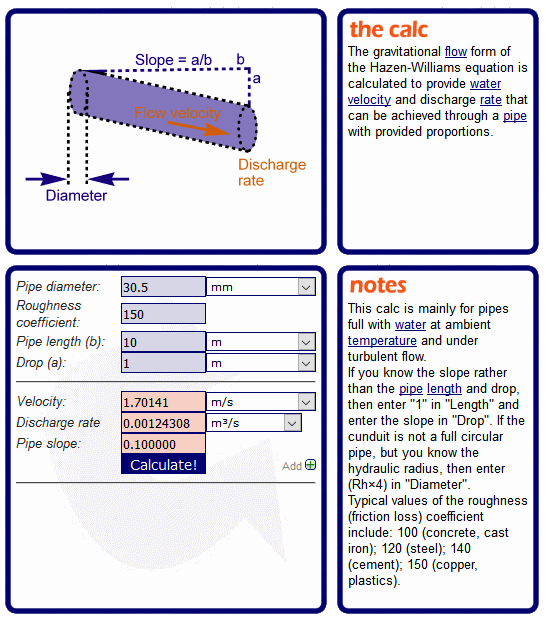
NOTE that the Hazen-Williams calculator is inaccurate for syphonic pipe lengths less than 6 m long.
Q. Got a question?
A. Feel free to call, we're available 7 days a week. Phone (03)97045339
A. Feel free to call, we're available 7 days a week. Phone (03)97045339