






Are water tank overflow pipes always needed?
Diverting additional downpipes often causes the inflow capacity to exceed a water tank’s overflow capacity during heavy rain.
- Water
tank overflow outlets or pipes are required to be fitted with either
mosquito proof mesh or a flap valve. The mesh typically has an open
area of about 55% which presents a flow restriction within the
overflow pipe.
- Many
water tanks are designed with very high overflow outlets which
severely reduce a tank’s mitigation and discharge capacity.
- Water
tank manufacturers rarely if ever provide information about a tank’s
overflow capacities.
- An
organic film floats on the tank’s water surface during and after
rain. This often gels to the overflow mesh during overflows, causing
an increased flow restriction.
- Overflow
pipes are often costly to install.
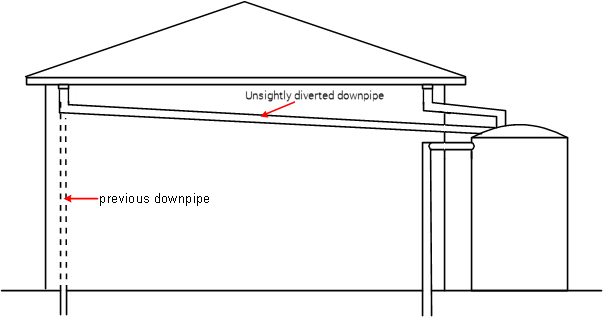
- Downpipes
diverted along walls are ugly.
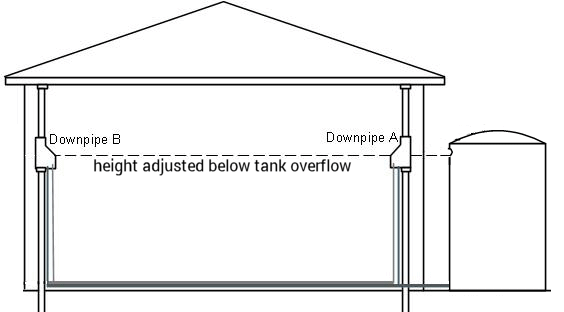
BUT height adjusting SUPADIVERTAs to downpipes can eliminate the need for a water tank overflow pipe!
- A
SUPADIVERTA height adjusted on a downpipe with the top of the
reservoir wall 2 cm below the bottom of the tank’s overflow outlet
will overflow back to the stormwater system when the tank fills.
- If
no other downpipes drain to the water tank’s top meshed inlet,
there is no need for a water tank overflow pipe!
- Deleting
or capping a water tank’s overflow outlet increases storage
capacity. It also allows the Supadiverta to be fitted higher on the
downpipe to generate increased head pressure.
- If
a tank already has an overflow pipe connected and a downpipe diverts
to the tanks top meshed inlet, additional downpipes can be diverted
to the tank by Supadivertas without affecting the tank’s overflow
capacity.
- Using
Supadivertas which divert rainwater to stormwater when the tank is
full reduces sediment build up.
- House
brick mortar lines or weatherboards can be used as a ‘line of
sight’ when fitting a Supadiverta.
- Subject
to slope, locating a tank away from the house is no longer difficult
and expensive.
- SUPADIVERTA
diverts water, not downpipes.
- Neater
and cheaper rainwater harvesting.
Any number of downpipes can be harvested by this method